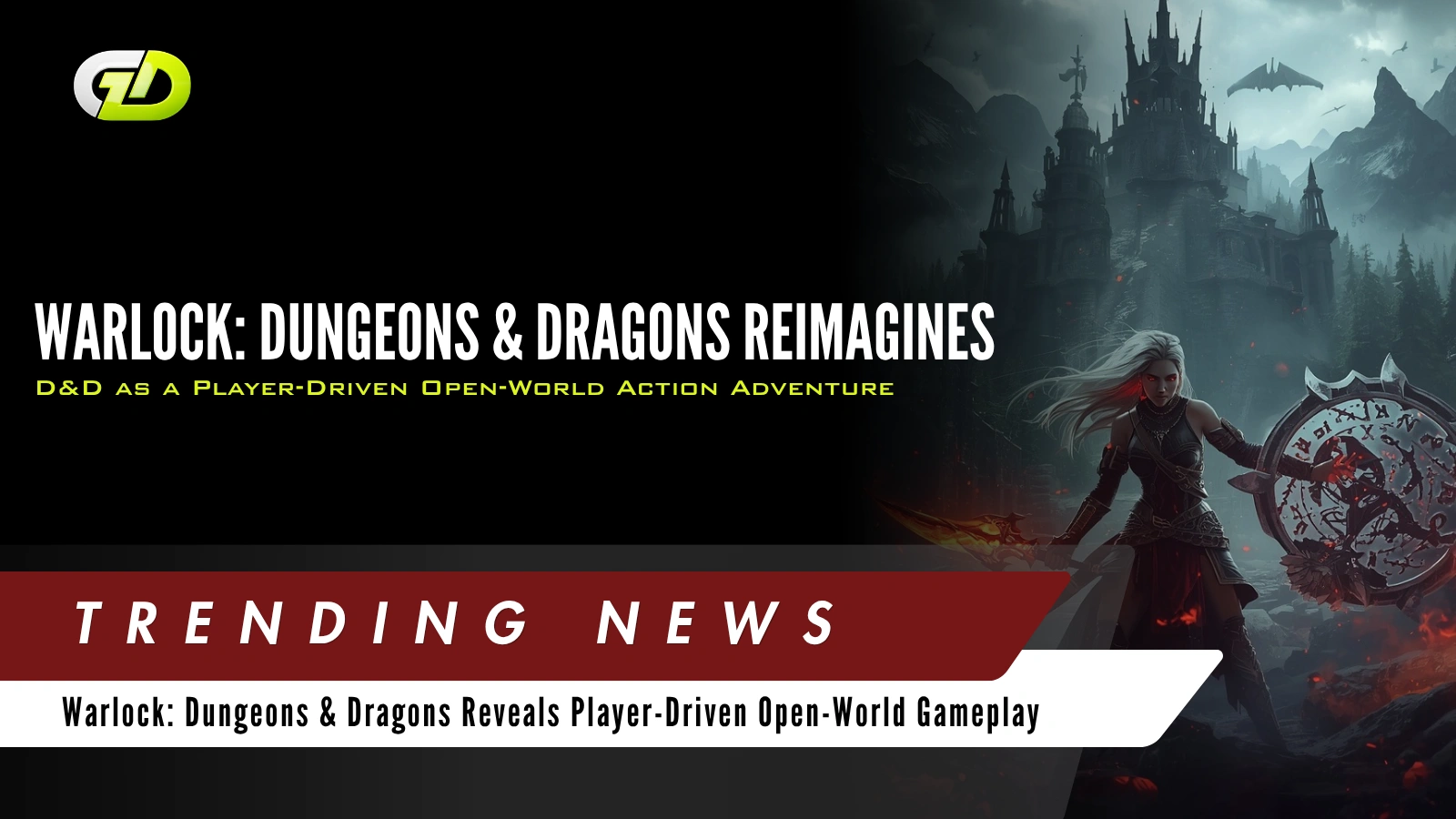
Warlock: Dungeons & Dragons Reimagines D&D as a Player-Driven Open-World Action Adventure
Warlock: Dungeons & Dragons brings the D&D universe into a real-time open-world action adventure, combining flexible magic, melee combat, exploration, and player-driven progression. Set in the dark realm of Darkon, the game gives players the freedom to shape Kaatri’s abilities and discover their own path through the world.
Aug 26, 2026
Wizards of the Coast and Montréal-based developer Invoke Studios have revealed new gameplay details for Warlock: Dungeons & Dragons, an upcoming single-player action-adventure that aims to translate the flexibility of tabletop D&D into a real-time open-world experience.
Rather than directly reproducing tabletop mechanics, the game focuses on exploration, flexible spellcasting, melee combat, and player choice, allowing players to approach challenges in different ways.
The game is currently scheduled to launch in 2027 for PC, PlayStation 5, and Xbox Series X|S.
A Warlock Powered by a Dangerous Pact
Players take control of Kaatri, a seasoned weapons master searching for someone important to her. Her journey leads her to Tasha, an ancient witch queen who becomes her patron and grants her access to Warlock abilities.
Kaatri's newfound powers revolve around Raw Magic, mysterious sources scattered throughout the world. Finding these sources allows players to unlock and upgrade spells while developing Kaatri's magical abilities.
The relationship between Kaatri and Tasha also plays an important role in progression, giving players opportunities to adapt certain spells to their preferred playstyle.
Magic Designed as a Tool, Not Just an Attack
One of the game's biggest gameplay focuses is the flexibility of its magic system.
Players will encounter familiar D&D spells such as Eldritch Blast, Gust of Wind, Levitate, and Black Tentacles, alongside new abilities created specifically for the game.
Importantly, spells aren't restricted to a single purpose.
For example, Black Tentacles can be used to control enemies during combat, disarm opponents, or even create temporary platforms that help Kaatri navigate the environment.
Another ability, Tasha's Leash, allows Kaatri to summon magical tendrils that can grab enemies or objects, pull them toward her, or throw them elsewhere.
This approach encourages players to experiment with their abilities rather than simply using spells according to predefined combat roles.
Magic and Melee Work Together
Kaatri isn't solely a spellcaster.
As a former weapons master and a Pact of the Blade Warlock, she can summon weapons during combat and switch between magical abilities and physical attacks.
The developers describe combat as a constant interaction between the two systems: magic can create openings, while melee weapons allow players to capitalize on those opportunities.
The result is intended to make combat feel more dynamic than traditional spell-based RPG encounters.
Exploring the Dark Realm of Darkon
Unlike many D&D games, Warlock isn't set in the familiar Forgotten Realms.
The game takes place in Darkon, one of D&D's Domains of Dread—a dangerous realm traditionally surrounded by impenetrable mist.
Darkon is in an unusual state because its ruling Dark Lord is rumored to have disappeared, leaving the region unstable.
Kaatri enters this unfamiliar world while searching for someone she cares about, accompanied by Skev, an imp native to Darkon who provides both narrative context and practical gameplay assistance.
An Open World Built Around Exploration
Invoke Studios is taking a relatively hands-off approach to exploration.
Rather than constantly directing players toward objectives, Warlock features a minimalistic map designed to encourage curiosity and discovery.
Players can investigate rumors, explore locations, uncover mysteries, find equipment, discover optional spells, and pursue side activities without necessarily following a strict path.
The world is also designed to be dense rather than unnecessarily enormous, with different environments and discoveries positioned to keep exploration engaging.
Some areas may only become accessible after players acquire specific spells, creating a progression system where magical growth also expands exploration possibilities.
Your Playthrough Can Be Different From Someone Else's
A major part of Warlock's progression system is that not every player is guaranteed to discover the same abilities.
Many spells are optional discoveries, meaning one player could find an ability that another player never encounters.
Players can also modify certain spells through their connection with Tasha, while equipment, magical items, armor, weapons, and talismans provide additional ways to specialize Kaatri.
This creates the possibility of players developing noticeably different builds and approaches during their playthroughs.
Player Choice Drives Combat and Encounters
Invoke Studios is also emphasizing player-driven encounters.
During the gameplay presentation, players could choose whether to confront dangerous enemies, avoid them, or manipulate the environment to gain an advantage.
Environmental systems can also interact with magic. For example, Kaatri can use a Downpour ritual to soak enemies and the surrounding terrain, making her Witch Bolt spell more effective.
The developers say the goal is to give players systems that they can combine creatively rather than forcing them toward a predetermined solution.
D&D Without the Dice
Despite its Dungeons & Dragons foundation, Warlock isn't designed to replicate tabletop D&D rules directly.
There will be no traditional dice-rolling system. Instead, the developers are adapting the underlying philosophy of D&D's magic and character flexibility into a real-time action-adventure format.
The team also wants the game to remain accessible to players who have never experienced D&D, while still including deeper references and lore for longtime fans.
Release
Warlock: Dungeons & Dragons is currently planned for 2027 on PC, PlayStation 5, and Xbox Series X|S.
Source: Wccftech
Expert Insights
GamesDapp, a game development company, sees Warlock: Dungeons & Dragons as a strong example of how established IP can be reimagined through player-driven systems rather than simply replicating its original format.
Its emphasis on flexible abilities, environmental interaction, and exploration highlights how player agency and systemic game design can create more varied and replayable experiences in modern action-adventure games.
Trending News