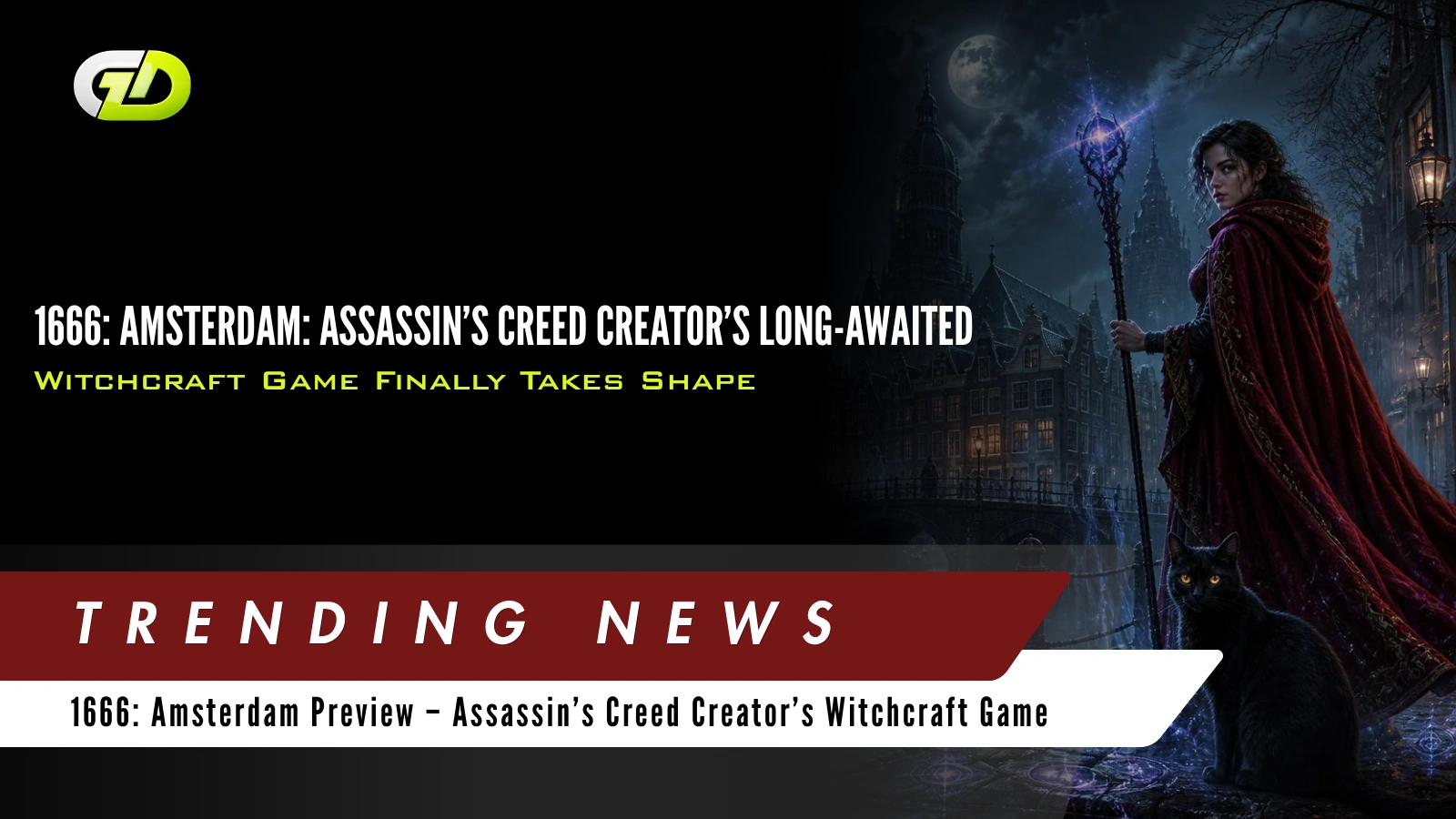
1666: Amsterdam: Assassin’s Creed Creator’s Long-Awaited Witchcraft Game Finally Takes Shape
Assassin’s Creed creator Patrice Désilets’ 1666: Amsterdam finally approaches Early Access, combining witchcraft, investigation, stealth, historical exploration, and dual-character gameplay.
Aug 11, 2026
After more than a decade of development challenges, legal disputes, studio changes, and uncertainty, 1666: Amsterdam is finally moving toward release. The long-awaited passion project from Assassin’s Creed creator Patrice Désilets is scheduled to enter Early Access on August 25, giving players their first substantial opportunity to experience its witchcraft-driven take on historical action-adventure.
Originally conceived more than 15 years ago while Désilets was working at Ubisoft, 1666: Amsterdam has undergone a complicated journey. The project eventually moved to Panache Digital Games and became tied up in a lengthy dispute over ownership rights. Now, with the game approaching Early Access, Désilets and his team are preparing to build the experience alongside its community.
A Witchcraft-Focused Adventure Across Three Eras
The playable build follows Noa Brooklyn, a young witch who has recently completed her initiation into the Zaindaris, a secretive magical faction. As a Collector, Noa is tasked with tracking down powerful supernatural beings known as Originals.
The Originals were once given an ancient form of magic called Nux in an attempt to elevate humanity. However, the power corrupted many of them, transforming them into dangerous entities capable of living among ordinary people.
Noa must investigate these beings, uncover their identities, and eventually hunt them down.
The story also moves beyond the 17th century. Players will experience events surrounding 1999 and a more contemporary timeline involving Clio, a woman investigating a mysterious letter connected to her father.
At the center of the story is Aaron, a young man transported to 1666 during a supernatural ritual. He awakens in the body of a cat and becomes Noa's familiar, creating an unusual partnership that forms a major part of the game's gameplay.
Investigation Is at the Heart of the Experience
Rather than relying entirely on traditional combat-focused missions, 1666: Amsterdam puts significant emphasis on investigation.
Players must search homes and businesses, examine clues, speak with citizens, and piece together information about each Original. Investigations take place during the day, while confrontations occur after nightfall.
The game also introduces roguelike elements to these hunts. Before pursuing an Original, players can select one of three randomly offered abilities, ranging from defensive upgrades to offensive powers such as Petrify.
This structure is intended to make each investigation more flexible, allowing players to approach their objectives through different strategies.
Combat and Witchcraft Abilities
Combat currently includes basic melee attacks, dodging, healing potions, and finishing moves. The hands-on build, however, still showed areas that need refinement, particularly with combat impact and enemy behavior.
Magic provides a more distinctive gameplay layer. Noa can use Nux energy to interact with the environment and attack enemies. Additional abilities shown by Panache include magical tendrils capable of restraining enemies and powers that can temporarily turn opponents to stone.
These abilities could ultimately give combat a more creative identity than traditional melee encounters.
A Dense and Interactive Amsterdam
Instead of creating an enormous open world purely for scale, Panache Digital Games is building a smaller but denser version of Amsterdam.
The studio, which has around 70 employees, aims to make buildings and interiors meaningfully explorable. Players can investigate locations, gather resources, find clues, and use different routes to reach restricted areas.
The game's visual direction is heavily influenced by 17th-century Dutch art, particularly the domestic interior paintings of Johannes Vermeer. This gives the digital version of Amsterdam a distinctive painterly aesthetic rather than simply pursuing photorealism.
Aaron Adds a Different Way to Explore
Aaron's role as Noa's feline familiar introduces another layer to exploration.
Players can switch control between Noa and Aaron, allowing them to approach situations differently. As a cat, Aaron can climb buildings, enter spaces that Noa cannot reach, distract guards, and even possess certain characters who are frightened by black cats.
This dual-character system could become one of the game's most interesting mechanics, as players must combine Noa's magical abilities with Aaron's mobility and possession powers to solve environmental challenges.
Stealth Comes With Consequences
Noa can switch between her witch and civilian appearances while exploring Amsterdam. Her civilian disguise attracts less attention, while openly using magic or behaving suspiciously can increase an attention meter.
If that meter reaches its limit, militia forces begin pursuing Noa. Players can either fight back or escape to safehouses, which also function as locations for crafting potions.
Getting captured can send Noa to prison, introducing another potential gameplay system that Panache is still refining.
Early Access Begins August 25
1666: Amsterdam will launch into Early Access on August 25 with the opening chapters available to players. Désilets describes the initial release as a substantial portion of the overall experience, while confirming that the game's broader story, lore, and core rules have already been established.
Panache plans to remain in Early Access for at least a year, using player feedback to refine and expand the game.
The development build shown to the media still had noticeable issues, including rough combat, inconsistent platforming, and areas that lacked polish. However, the underlying concepts provide a promising foundation.
After more than 15 years of development, 1666: Amsterdam is finally approaching its first major public test. Whether its ambitious investigation systems, witchcraft mechanics, dual-character gameplay, and historical setting can come together into a polished experience will become clearer once Early Access begins.
Source: Gameinformer
Expert Insights
From a game development company perspective, GamesDAPP sees 1666: Amsterdam as an interesting example of how strong gameplay concepts can evolve over years of development.
Its combination of investigation, player-driven exploration, supernatural abilities, and dual-character mechanics shows how distinctive systems can give a historical setting a fresh identity. The Early Access approach could also be valuable, allowing the developers to refine these ambitious ideas directly through player feedback before the full release.
Trending News